
Acquiring customers is hard. Keeping them is even harder.
Most D2C brands invest heavily in performance marketing, influencer collaborations, and social media campaigns to attract new customers. However, many struggle to manage customer relationships effectively once the first purchase is made.
That’s where CRM software becomes essential.
A Customer Relationship Management (CRM) system helps brands organize customer data, track interactions, automate communication, and create personalized experiences that drive repeat purchases.
In today’s competitive ecommerce landscape, relying on spreadsheets and manual follow-ups simply isn’t enough. The right CRM software can help D2C brands improve customer retention, increase lifetime value, and build stronger customer relationships.
Let’s explore some of the best CRM software for D2C brands and how they can support long-term growth.
Why D2C Brands Need CRM Software?
Modern customers expect personalized experiences.
Whether it’s a product recommendation, an abandoned cart reminder, or a loyalty reward, customers want brands to understand their preferences and shopping behavior.
A CRM helps brands:
- Centralize customer data
- Automate customer communication
- Improve customer retention
- Track customer journeys
- Increase repeat purchases
- Enhance customer support
Instead of managing customer information across multiple platforms, a CRM provides a single source of truth for your business.
Top CRM Software for D2C Brands
| CRM Software | Best For |
| HubSpot CRM | Growing D2C Brands |
| Zoho CRM | Budget-Friendly CRM |
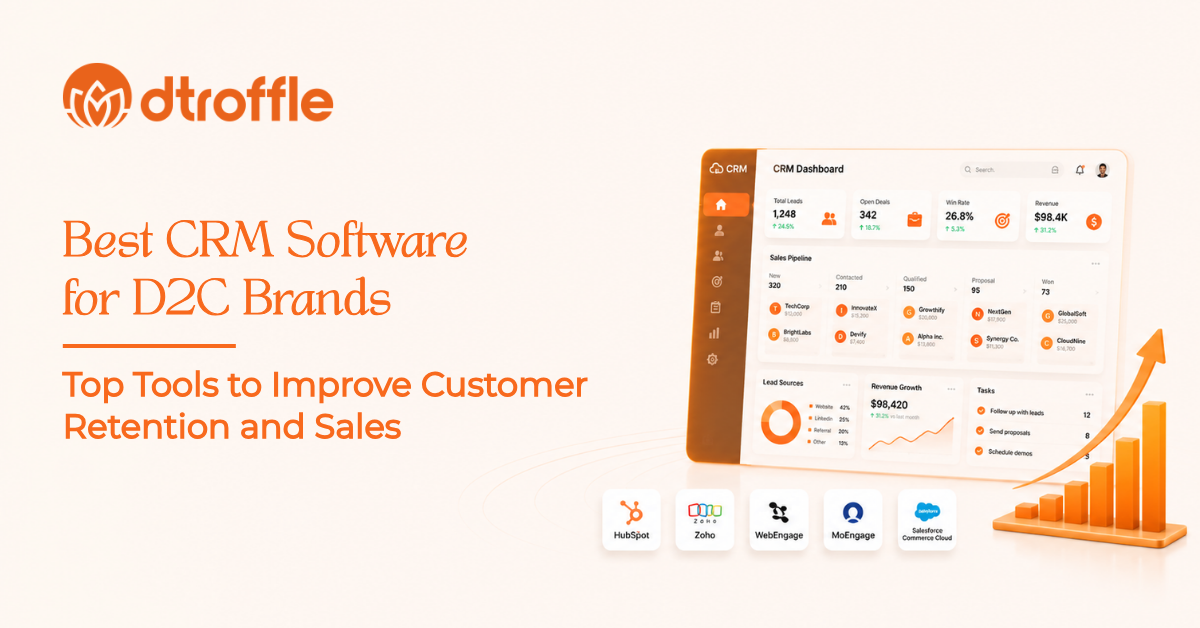
| WebEngage | Customer Retention & Engagement |
| MoEngage | Omnichannel Marketing |
| Salesforce Commerce Cloud | Enterprise D2C Brands |
1. HubSpot CRM – Best for Growing D2C Brands
HubSpot is one of the most popular CRM platforms because of its ease of use and powerful automation capabilities.
It allows brands to manage customer interactions, automate workflows, track leads, and create personalized customer experiences without requiring a complex setup.
Key Features:
- Contact management
- Email marketing automation
- Sales pipeline tracking
- Customer segmentation
- Reporting dashboard
Best For: Growing D2C brands looking for an easy-to-use and scalable CRM solution.
2. Zoho CRM – Best Budget-Friendly Option
For startups and emerging D2C brands, Zoho CRM offers a strong feature set at an affordable price.
It helps businesses manage customer relationships, automate tasks, and track sales performance without a significant investment.
Key Features:
- Lead management
- Workflow automation
- Customer analytics
- Multichannel communication
- Custom dashboards
Best For: Small and mid-sized D2C businesses with limited budgets.
3. WebEngage – Best for Customer Retention
WebEngage is particularly popular among ecommerce and D2C brands because of its focus on customer engagement and retention.
The platform enables brands to create personalized campaigns based on customer behavior across multiple touchpoints.
Key Features:
- Customer journey mapping
- Behavioral segmentation
- Email automation
- Push notifications
- Retention analytics
Best For: Brands focused on improving retention and customer lifetime value.
4. MoEngage – Best for Omnichannel Engagement
Today’s customers interact with brands across multiple channels.
MoEngage helps D2C brands connect with customers through email, SMS, WhatsApp, push notifications, and mobile apps from a single platform.
Key Features:
- Omnichannel communication
- Customer analytics
- AI-powered segmentation
- Automation workflows
- Real-time engagement tracking
Best For: Brands looking to deliver consistent customer experiences across channels.
5. Salesforce Commerce Cloud – Best for Enterprise Brands
For large-scale D2C businesses, Salesforce offers one of the most comprehensive CRM ecosystems available.
Its advanced features help brands manage customer relationships, sales processes, marketing automation, and ecommerce operations at scale.
Key Features:
- Advanced reporting
- Customer insights
- Marketing automation
- AI-powered recommendations
- Enterprise-level scalability
Best For: Large D2C brands with complex customer management requirements.
How to Choose the Right CRM for Your D2C Brand?
Before selecting a CRM, consider the following factors:
Business Size: A startup may not need the same level of functionality as an enterprise brand. Choose a solution that matches your current growth stage.
Automation Capabilities: Look for CRM software that can automate repetitive tasks such as follow-up emails, customer segmentation, and lead nurturing.
Integration Options: Ensure the CRM integrates with your ecommerce platform, email marketing tools, customer support software, and advertising channels.
Scalability: The CRM should be able to grow alongside your business and support future expansion.
Common CRM Mistakes D2C Brands Make
Many brands invest in CRM software but fail to maximize its potential.
Some common mistakes include:
- Not segmenting customers properly
- Ignoring customer behavior data
- Failing to automate workflows
- Using CRM only for sales tracking
- Not integrating it with marketing tools
A CRM should be viewed as a growth tool rather than just a customer database.
How Dtroffle Can Help You Scale Faster?
Choosing the right CRM is only one part of building a successful D2C brand. At Growth Lab by Dtroffle, we provide end-to-end digital marketing solutions that combine CRM strategy, performance marketing, retention campaigns, email automation, SEO, content, and analytics to help brands acquire, retain, and grow customers. Whether you’re launching or scaling, we help turn data into sustainable business growth.
FAQs: About CRM Software for D2C Brands
Q 1. What is the best CRM software for D2C brands?
Ans: HubSpot, Zoho CRM, WebEngage, MoEngage, and Salesforce are among the most popular CRM solutions for D2C businesses.
Q 2. Why do D2C brands need a CRM?
Ans: A CRM helps brands manage customer relationships, automate communication, improve retention, and increase customer lifetime value.
Q 3. Which CRM is best for startups?
Ans: Zoho CRM and HubSpot CRM are excellent choices for startups due to their affordability and ease of use.
Q 4. Can CRM software help increase sales?
Ans: Yes. CRM software enables brands to personalize customer interactions, automate follow-ups, and improve retention, all of which can contribute to higher sales.
Final Thoughts: CRM Software for D2C Brands
As customer acquisition costs continue to rise, retaining existing customers has become more important than ever. The right CRM software can help D2C brands build stronger customer relationships, streamline communication, and create personalized experiences that drive long-term growth.
Whether you’re a startup looking for an affordable solution or an established brand seeking advanced automation, investing in the right CRM can have a significant impact on customer retention, sales performance, and overall business success.
You May Also Like to Know: