
For D2C brands, getting customers to discover a product online is only half the challenge. The bigger question is how to attract the right audience without spending more than necessary to acquire each customer.
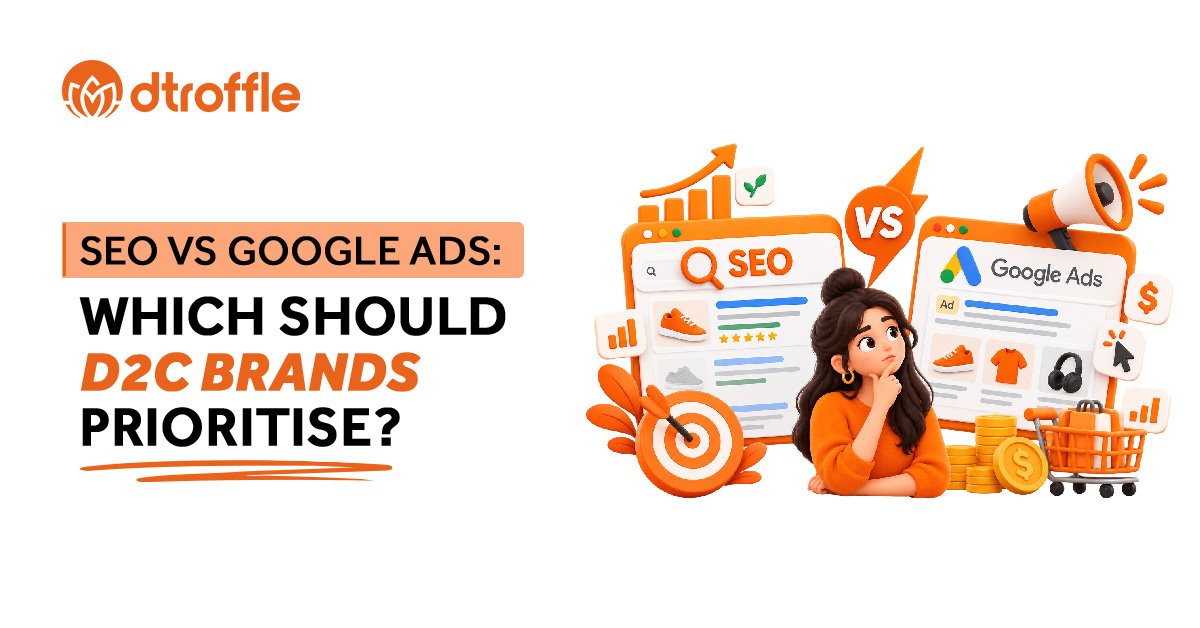
Two common approaches are search engine optimization (SEO) and Google Ads. Both help brands reach people searching for products, but they work differently. SEO focuses on earning visibility in organic search results, while Google Ads allows brands to pay for advertising placements.
So, which should D2C brands prioritise?
The answer depends on how quickly you need results, your marketing budget, your competition, and your long-term growth goals. Understanding what each channel offers can help you make a more informed decision.
What Is the Difference Between SEO and Google Ads?
SEO involves improving your website’s content, structure, and technical performance to help search engines understand your pages and show them in relevant organic search results.
For example, a skincare brand might optimize its product pages for searches related to moisturizers for dry skin. It could also publish helpful content answering common skincare questions.
Google Ads, on the other hand, allows brands to advertise products to people searching for relevant terms. Advertisers can set budgets, choose targeting options, test ad messages, and measure campaign performance.
Here is how the two approaches compare:
| Factor | SEO | Google Ads |
| Visibility | Earned through organic search | Paid advertising placements |
| Timeframe | Usually builds over time | Ads can start appearing after approval |
| Cost structure | Investment in content, technical improvements, and SEO resources | Advertising spend, plus campaign management costs where applicable |
| Traffic | Can continue without paying for each organic click | Depends on active campaigns, budgets, and ad delivery |
| Control | Search engines determine organic placement | Advertisers control budgets, targeting, and campaign settings |
| Best suited for | Long-term organic visibility | Faster visibility and controlled campaign testing |
Neither channel guarantees sales. Both depend on search demand, competition, website quality, and how effectively the brand converts visitors into customers.
When Should D2C Brands Prioritise SEO?
SEO is particularly valuable when a brand wants to build sustainable organic visibility and attract customers who are already searching for its products or related information.
Unlike paid advertising, organic search does not charge the brand for every click. However, SEO requires ongoing investment in content, website improvements, and performance monitoring.
D2C brands should consider prioritising SEO when:
- They want long-term growth: Relevant category pages, product pages, and helpful content can attract organic visitors over time.
- Their customers actively search for products: Search demand creates opportunities to reach people researching or comparing products.
- They want to reduce dependence on paid traffic: Organic visibility can become another source of customer acquisition.
- Their website has content gaps: Better product descriptions, category pages, and useful buying guides can address customer questions and search intent.
- They are building brand authority: Helpful, relevant content can introduce potential customers to the brand before they are ready to purchase.
For example, a D2C haircare brand could create useful content around choosing products for different hair types while optimizing its category and product pages for relevant searches.
The important thing to remember is that SEO takes time, and competitive keywords can be difficult to rank for. Results depend on the website’s starting point, the competition, and the quality of the work.
When Should D2C Brands Prioritise Google Ads?
Google Ads can be useful when a brand needs faster visibility or wants to test demand for a product before investing heavily in long-term organic growth.
Unlike SEO, paid search can bring a brand into relevant search results without waiting to earn an organic ranking. However, campaign performance depends on targeting, competition, bidding, the offer, and the landing page.
Google Ads may be the better immediate priority when:
- Launching a new product: Paid campaigns can help introduce a product to people searching for related items.
- Promoting seasonal offers: Brands can adjust campaigns around sales, festivals, and limited-time promotions.
- Testing customer demand: Search terms, ad messages, and conversion data can help evaluate which products or offers attract customers.
- Targeting high-intent searches: Ads can reach users searching for specific products or solutions.
- Generating sales within a defined timeframe: Paid campaigns provide a way to pursue short-term acquisition goals when the economics support it.
For example, a D2C fashion brand launching a festive collection could use Google Ads to promote relevant products during the shopping season while working on SEO for longer-term visibility.
However, faster traffic does not automatically mean profitable growth. Brands must account for advertising costs, product margins, conversion rates, returns, and customer acquisition costs.
Google Ads can provide immediate opportunities for visibility, but it does not improve a website’s organic rankings simply because the brand is spending on advertising.
Which Channel Is More Cost-Effective?
Cost-effectiveness depends on the business, not just the channel.
SEO does not require payment to Google for organic clicks, but it still involves costs such as content creation, technical improvements, tools, and specialist resources. Its value may increase as a website earns more relevant organic traffic, although rankings and traffic are never guaranteed.
Google Ads requires ongoing advertising spend. It can generate sales quickly, but costs may rise when competition is high or campaigns attract visitors who do not convert.
D2C brands should compare both channels using business metrics rather than traffic alone.
Consider these metrics:
- Customer acquisition cost (CAC): How much does it cost to acquire a customer?
- Conversion rate: What percentage of visitors complete a purchase?
- Revenue: How much revenue can be attributed to each channel?
- Contribution margin: How much remains after relevant variable costs?
- Return on ad spend (ROAS): How much revenue is generated for each unit of advertising spend?
- Organic performance: Are non-paid clicks, relevant rankings, and organic conversions improving over time?
For Google Ads, monitor advertising spend alongside the profitability of the orders it generates. For SEO, evaluate the investment against organic traffic, conversions, and revenue over a suitable period.
A channel that generates more traffic is not necessarily the channel that delivers more profitable customers.
Should D2C Brands Use SEO and Google Ads Together?
For many D2C brands, the strongest approach is to use both channels with clearly defined roles.
Google Ads can support immediate acquisition and testing, while SEO builds organic visibility over time. Insights from one channel can also help improve the other.
For example, a brand might discover through Google Ads that certain product-related searches generate more purchases than others. It can use that information to inform its SEO priorities, product page content, and category page strategy.
A combined approach can include:
- Using Google Ads to test commercial search terms and offers.
- Prioritising SEO for relevant product and category pages.
- Creating helpful content around questions customers frequently ask.
- Improving landing pages to support both paid and organic visitors.
- Measuring conversions and revenue across both channels.
- Reviewing performance regularly and adjusting investment based on results.
- The goal is not to spend equally on both channels. It is to give each channel a clear purpose and allocate resources according to business needs.
How Should a D2C Brand Decide Where to Start?
Before choosing a channel, evaluate your current position.
- If you need sales quickly: Consider Google Ads when there is relevant search demand, your website is ready to convert visitors, and your margins support paid acquisition.
- If you are building long-term visibility: Prioritise SEO foundations, including technical health, product page optimization, category page content, and relevant keyword research.
- If you are launching a new product: Use controlled paid campaigns to test demand while building organic visibility around the product and its category.
- If paid acquisition is becoming expensive: Investigate opportunities to grow organic traffic, improve conversion rates, and understand which paid campaigns remain profitable.
- If you already have traffic but few sales: Review your product pages, pricing, checkout experience, and conversion tracking before increasing spending on either channel.
- There is no universal budget split that works for every D2C brand. Your decision should reflect your growth stage, competition, available resources, and ability to convert traffic into profitable sales.
Conclusion
SEO and Google Ads solve different problems, and choosing between them should depend on what your D2C brand needs most.
SEO helps build organic visibility over time, while Google Ads offers a way to reach relevant searchers more quickly through paid placements. One is not automatically better than the other.
For brands seeking immediate visibility, Google Ads may deserve greater initial attention. For brands focused on building long-term organic growth, SEO deserves consistent investment. Many businesses can benefit from combining both, provided they measure performance and allocate budgets carefully.
The real question is not whether SEO is better than Google Ads. It is which channel can help your brand achieve its current goals while building a stronger foundation for future growth.