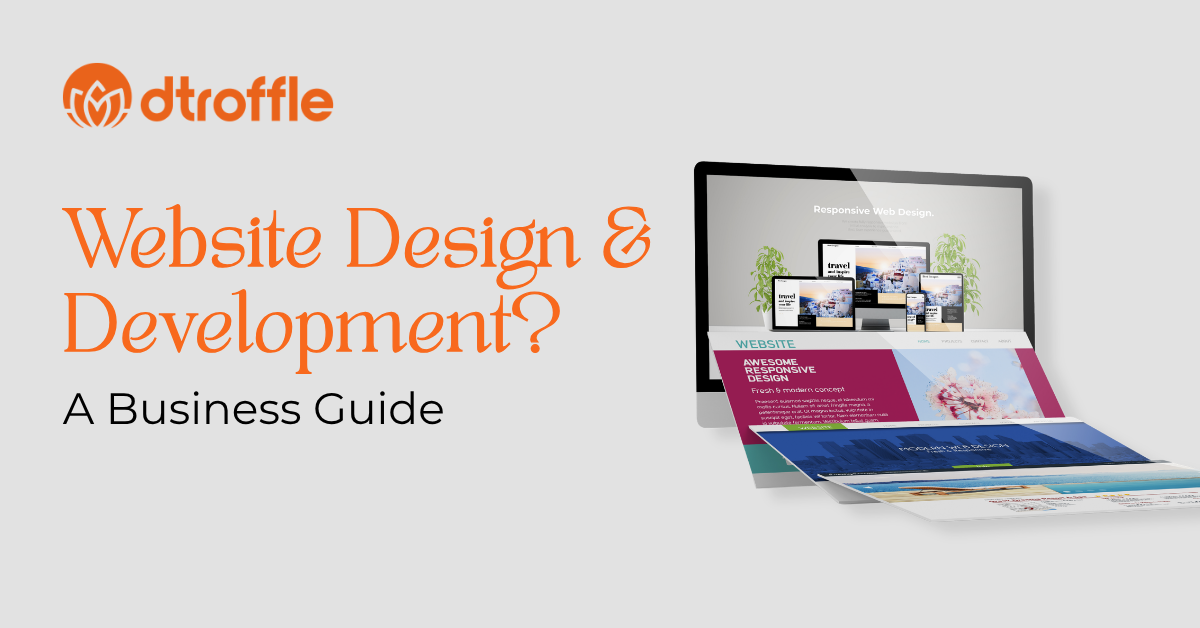
What is Website Design & Development?: Website design focus on how website looks and feels to users. It is about visual appeal, user experience, and usability. While website development is the technical process that brings the design to life. It ensure the website works smoothly, loads fast, and performs across devices.
Moreover website design focus on asthetics and usability using tools like Figma, Adobe XD, Sketch, whereas webdevelopment builds functionality with languages like HTML, CSS, JavaScript, and server side code, ensuring smooth operations and interectivity.
Difference Between Web Design and Development
| Aspects | Website Design |
Website Development
|
| Focus | Visual appeal, Layout, Branding, and User experience |
Technial functionality, Site structure, and Performance
|
| Role | To create a visual appealing, intutive, and user-friendly interface. |
To build and maintaining the actual, working website or application using code.
|
| Skills Require | Creativity, graphic designing, color theory, typography, and empathy for user behavior. |
Logical hinking, problem solving, programming proficiency, and database management.
|
| Responsibilities | Choosing color scheme, fonts, creating wireframe, mockups, and ensuring intutive navigation. |
Writing clean maintanable code (HTML, CSS, Javascript), Building & Managing database, Developing APIs, Optimizaing site performance.
|
| Key Areas | UI/UX design, Graphic design, Interaction design, and Information Architecture design. |
Front-end development, Backe-End development, full stack developement, and DevOps.
|
| Tools & Languages | Design software like Figma, Adobe XD, Sketch, and Photoshop |
Coding languages (HTML, CSS, JavaScript, Python, PHP), Frameworks (React, Anular), and tools like Github and Code editor.
|
How Do Web Design & Development Work Together?
At a professional Website Design & Development company, web design and development operate as a single, connected process. Designers create structured blueprints through wireframes and mockups, defining the user experience and visual direction. Developers then transform these blueprints into a live, interactive website using HTML, CSS, JavaScript, PHP, and platform-specific tools. Let’s understand how Dtroffle’s web design and development team collaborates to create high-performance websites.
How They Work Together?
At Dtroffle, we design and develop websites using WordPress, Shopify, Wix, and WooCommerce, based on the client’s business model, scalability needs, and growth goals.
We focus on these platforms because they offer proven stability, scalability, security, and strong ecosystem support. They allow faster deployment, easier management, and long-term flexibility, making them ideal for growing businesses and brands.
While the platforms may differ, the core design–development process remains structured, collaborative, and growth-focused.
1. Concept & Planning
The process starts with understanding goals, leading to site structure (UX) and visual style (UI).
Every successful website starts with clarity. At this stage, we focus on understanding the client’s business goals, whether the objective is lead generation, online sales, brand building, or long-term scalability. We analyze target audience behavior to ensure the website structure aligns with how users search, navigate, and convert. Based on business requirements, we carefully choose the most suitable platform: WordPress for service-based and content-driven websites, Shopify for D2C and e-commerce brands, WooCommerce for flexible e-commerce solutions on WordPress, and Wix for faster deployment for small businesses.
Once the platform is finalized, we define the website’s UX structure, key pages, user journeys, and conversion goals such as enquiry forms, CTAs, or checkout flows. This planning phase ensures a clear site architecture, a logical user flow, and a platform choice that supports long-term business growth.
2. Website Design (UX/UI)
Once the planning is finalized, we move into the design phase where the website’s look, feel, and user flow are created. Our designers focus on building a user-friendly and visually consistent experience that reflects the brand identity. Using tools like Figma, we design wireframes and UI layouts that define page structure, navigation flow, color palette, typography, and content placement.
Special attention is given to mobile-first design and conversion-focused elements such as CTAs, forms, and product layouts. The goal is to create a clean, intuitive, and engaging interface that guides users smoothly toward action while remaining feasible within the selected platform-WordPress, Shopify, WooCommerce, or Wix.
3. Website Development
At this stage, the approved designs are transformed into a fully functional website. Our developers convert the Figma-based UI designs into responsive, user-facing layouts using HTML, CSS, and JavaScript, ensuring the website works smoothly across all devices and browsers.
At the same time, back-end development is implemented to power the website’s core functionality. Depending on the selected platform – WordPress, Shopify, WooCommerce, or Wix, this includes CMS setup, content and product management, plugin or app configuration, payment gateway setup, form handling, database management, and required third-party integrations such as CRM, analytics, and communication tools. This combined development approach ensures the website is visually accurate, technically stable, secure, and scalable to support long-term business growth.
4. Integration & Testing
After development, designers and developers collaborate closely to integrate all features and thoroughly test the website. This includes testing forms, checkout flows, animations, integrations, and tracking tools. We check website performance, responsiveness, accessibility, and browser compatibility while identifying and fixing bugs or inconsistencies. Platform-specific testing is also performed, such as Shopify checkout validation, WooCommerce payment testing, WordPress plugin conflict checks, and Wix responsiveness testing. This step ensures the website is stable, optimized, and ready for real users.
Why Website Design & Development Matter for Business Growth?
A growth-ready website builds trust, improves lead quality, supports SEO and paid ads, increases conversion rates, and provides a scalable digital foundation. Your website is not just a visual asset, it is the core of your digital marketing ecosystem.
At Dtroffle, our website design & development services include strategic UX/UI design, responsive website development, WordPress and Shopify solutions, WooCommerce and Wix websites, custom functionality, e-commerce development, performance optimization, SEO-ready architecture, third-party integrations, security implementation, testing, launch support, and ongoing maintenance for scalable business growth.
Role of Website Design & Development in SEO
SEO success starts at the website level. A well-designed and developed website supports clean URL structures, fast loading speeds, mobile-first indexing, proper heading hierarchy, internal linking, and schema readiness. Core Web Vitals, technical SEO foundations, and crawl-friendly architecture are considered during development, ensuring the website is search-engine friendly from day one.
Website Accessibility & Usability
Modern websites must be accessible to all users. We ensure readable typography, proper color contrast, mobile usability, intuitive navigation, and basic accessibility compliance to support diverse users and improve overall experience. Accessibility enhances usability, engagement, and brand credibility.
Website Security & Reliability
Security is a critical part of development. We implement SSL certificates, secure hosting configurations, platform-specific security measures, safe payment gateway integrations, regular updates, and backup solutions. This ensures data protection, website stability, and user trust-especially for e-commerce and lead-driven websites.
Analytics, Tracking & Performance Monitoring
A website should be measurable. We integrate analytics and tracking tools such as Google Analytics (GA4), Google Search Console, and ad conversion tracking to monitor traffic, user behavior, and conversions. This data-driven approach allows continuous optimization and better marketing performance.
Launch & Ongoing Maintenance
Once testing is complete, the website is launched with final SEO checks, performance optimization, and tracking verification. Post-launch, we provide ongoing support including content updates, speed improvements, UX refinements, CRO enhancements, security updates, and platform upgrades. Website design and development are treated as continuous processes that evolve with business goals.
Final Thoughts
Website design and development are not separate tasks-they are deeply connected processes that determine how effectively a website performs. When design, development, performance, SEO, and strategy work together, websites become powerful business tools.
At Dtroffle, we build websites that don’t just look good-they work, convert, and scale.