
Getting people to visit your website is only the beginning.
You can invest in Meta Ads, Google Ads, influencer marketing, SEO, and social media to bring thousands of potential customers to your website. But if the website doesn’t make it easy for them to understand, trust, and buy from your brand, that traffic can quickly go to waste.
For D2C brands, the website is more than an online store.
It is your storefront, salesperson, customer experience platform, and one of the most important touchpoints between your brand and your customers.
A slow product page, complicated navigation, unclear messaging, or difficult checkout process can make potential customers leave before completing a purchase.
That’s why choosing the right D2C Website Features is essential.
A well-designed D2C website should combine attractive design, simple navigation, strong product presentation, trust signals, and a frictionless buying experience.
So, what should every D2C website include?
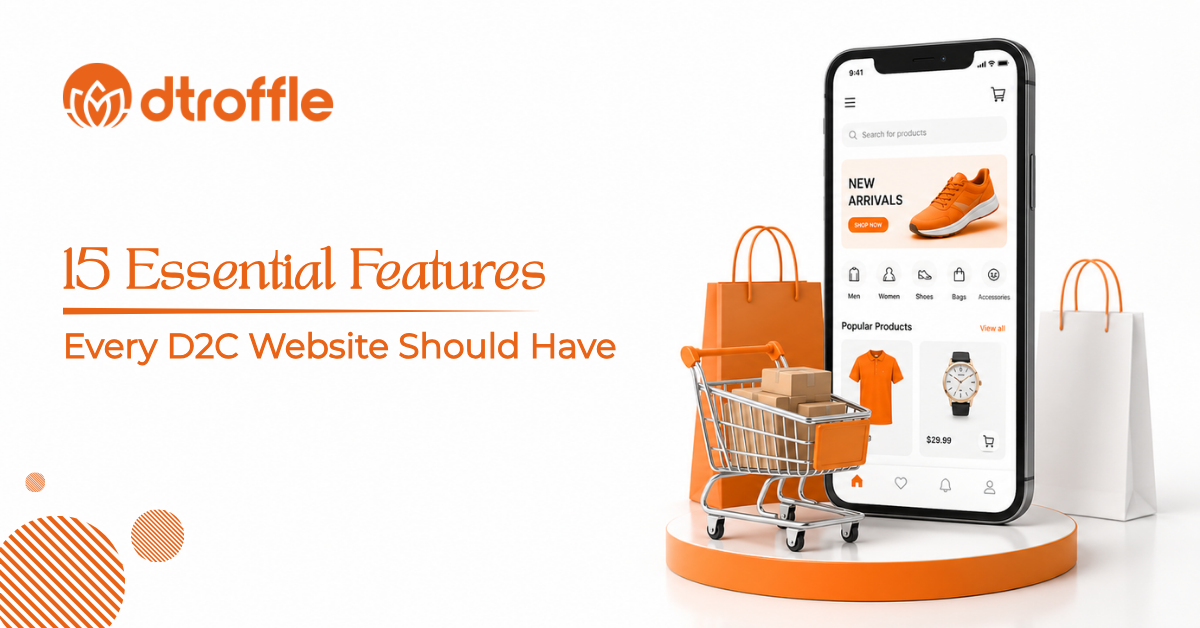
Let’s explore the 15 essential features that can help ecommerce brands create a better customer experience and improve conversions.
Why Are D2C Website Features Important?
Before adding features to your website, understand what they are actually supposed to achieve.
A D2C website should help customers:
- Discover your products easily
- Understand your brand and products
- Compare available options
- Trust your business
- Complete purchases quickly
- Find answers to their questions
- Return and purchase again
- The goal isn’t to add every possible feature.
The goal is to build a conversion-focused website where every element has a purpose.
For brands investing in D2C Website Development, focusing on functionality and customer experience can make a significant difference in overall ecommerce performance.
15 Essential Features Every D2C Website Should Have
1. Clear and Easy Navigation
Customers shouldn’t have to search through multiple pages to find what they need.
Your website navigation should be simple, logical, and easy to understand. Categories, collections, product pages, and important information should be accessible within a few clicks.
A clear navigation structure also makes it easier for search engines to understand your website.
What to Include:
- Simple menu structure
- Product categories
- Search bar
- Collection pages
- Easy access to cart and account
Good navigation improves both Ecommerce User Experience and website usability.
2. Mobile-Friendly Design
A large portion of ecommerce traffic comes from smartphones.
If your website looks great on desktop but feels difficult to use on mobile, you could be losing potential customers.
A Mobile-Friendly Ecommerce Website should automatically adapt to different screen sizes while keeping important elements easy to access.
Make Sure Your Mobile Website Has:
- Easy-to-tap buttons
- Readable text
- Responsive product images
- Simple menus
- Fast loading pages
- Mobile-friendly checkout
Mobile optimization should be a priority, not an afterthought.
3. Fast Website Loading Speed
Customers don’t want to wait for a website to load.
Slow pages can create frustration and increase the chances of users leaving before they even see your products.
Website speed is particularly important for D2C brands running paid advertising because you’re paying to bring users to your website.
If the landing page is slow, your advertising investment can become less effective.
That’s why Website Conversion Optimization should include performance and speed optimization.
Focus On:
- Optimized images
- Lightweight design elements
- Efficient apps and plugins
- Fast hosting
- Clean website structure
4. High-Quality Product Pages
Your product page is where interest turns into action.
Customers need enough information to understand what they’re buying without having to search elsewhere.
A strong product page should clearly communicate the product’s value, benefits, pricing, availability, and important specifications.
Essential Product Page Elements:
- High-quality product images
- Product videos where relevant
- Clear product descriptions
- Pricing
- Product variants
- Size or specification information
- Reviews
- Clear CTA
For brands investing in Ecommerce Website Design, product pages should be designed around the customer’s buying journey.
5. Strong Product Search and Filters
As your product catalogue grows, finding the right product can become difficult.
A search function allows customers to quickly find what they’re looking for.
Filters make the experience even easier.
For example, an apparel brand could allow customers to filter products by:
- Size
- Colour
- Price
- Category
- Material
- Availability
This can significantly improve the overall shopping experience.
6. Customer Reviews and Ratings
Customers want reassurance before making a purchase.
Reviews, ratings, testimonials, and user-generated content can provide that reassurance by showing potential buyers that other customers have already purchased and experienced the product.
For D2C brands, social proof can be especially valuable because customers may not have encountered the brand offline.
Useful Social Proof Includes:
- Star ratings
- Customer reviews
- Customer photos
- Video testimonials
- Product-specific reviews
Trust signals can help reduce hesitation and support better conversion rates.
7. Clear Calls-to-Action
Every important page should tell the customer what to do next.
A vague or hidden CTA can create unnecessary friction.
Instead, use clear and action-oriented buttons such as:
- Add to Cart
- Buy Now
- Shop Collection
- Get Started
The CTA should also be visually easy to identify.
A well-planned CTA structure is an important part of D2C Website Design because it guides customers through the buying journey.
8. Simple and Secure Checkout
You’ve successfully convinced a customer to buy.
Now don’t lose them at checkout.
A complicated checkout process can lead to cart abandonment.
Your checkout should be simple, transparent, and easy to complete.
Consider Including:
- Guest checkout
- Multiple payment options
- Minimal form fields
- Clear shipping costs
- Delivery information
- Secure payment indicators
- Easy order summary
For brands working on Ecommerce Website Development, checkout optimization should be treated as a core conversion priority.
9. Multiple Payment Options
Customers have different payment preferences.
Some prefer cards, while others may use UPI, wallets, net banking, or other payment methods.
Offering multiple secure payment options can make purchasing more convenient.
For Indian D2C brands especially, supporting familiar payment methods can reduce friction during checkout.
10. Personalized Shopping Experience
Not every customer has the same interests.
Personalization can help make your website more relevant by showing customers products or content based on their browsing and purchasing behavior.
Examples include:
- Recommended products
- Recently viewed products
- Related products
- Personalized offers
- Frequently bought together
As your brand grows, personalization can become an important part of your D2C Ecommerce Website strategy.
11. Wishlist and Save-for-Later Options
Not every visitor is ready to purchase immediately.
A wishlist allows customers to save products they are interested in and return to them later.
This is particularly useful for higher-priced products or customers who are comparing different options.
A wishlist can also create opportunities for future remarketing and customer engagement.
12. Strong Trust and Brand Information
Customers want to know who they’re buying from.
A professional website should communicate your brand story, values, policies, and credibility.
Important trust-building pages can include:
- About Us
- Contact Us
- Shipping Policy
- Return & Refund Policy
- Privacy Policy
- Terms & Conditions
For newer D2C brands, these elements can be especially important for establishing credibility.
A professional Ecommerce Website Design should make trust visible throughout the customer journey.
13. Live Chat and Customer Support
Customers often have questions before making a purchase.
They may want to know:
“Which size should I choose?”
“When will my order arrive?”
“Can I return this product?”
Providing quick support can prevent customers from leaving your website.
Depending on your business, you can use:
- Live chat
- Chatbots
- Email support
- FAQs
Good customer support improves the overall ecommerce experience and can help remove purchase barriers.
14. SEO-Friendly Website Structure
A beautiful website isn’t enough if potential customers can’t find it through search engines.
Your website should have a structure that supports SEO from the beginning.
Important SEO Elements Include:
- Optimized page titles
- Meta descriptions
- SEO-friendly URLs
- Proper heading structure
- Internal linking
- Image alt text
- Product schema
- Crawlable navigation
- Optimized category pages
This is where D2C Website Development and SEO should work together rather than being treated as separate activities.
15. Analytics and Conversion Tracking
How do you know whether your website is actually performing?
You need data.
Analytics and tracking tools can help you understand where visitors come from, what pages they visit, where they drop off, and which actions lead to purchases.
Track metrics such as:
- Website traffic
- Conversion rate
- Add-to-cart rate
- Checkout abandonment
- Average order value
- Revenue
- Customer acquisition cost
Data allows brands to continuously improve their website instead of making decisions based only on assumptions.
How Dtroffle Can Help Build a Better D2C Website?
Having the right features is important, but implementing them strategically is what creates a website that actually supports growth.
At Dtroffle, we help ecommerce and D2C brands build conversion-focused websites with strong design, user experience, SEO, performance, and ecommerce functionality. From D2C Website Design and Shopify Website Development to website optimization and digital marketing, the focus is on creating a website that doesn’t just look good but supports your overall business goals.
A strong website becomes even more valuable when it’s connected with SEO, performance marketing, content, and analytics-creating a complete digital growth ecosystem for your brand.
How to Choose the Right Website Features for Your D2C Brand?
You don’t necessarily need every advanced feature from day one.
Start by understanding your customers and business goals.
If You’re a New D2C Brand
Prioritize:
- Mobile responsiveness
- Fast loading speed
- Product pages
- Secure checkout
- Payment options
- Reviews
- Basic SEO
If You’re a Growing D2C Brand
Consider adding:
- Advanced filters
- Personalization
- Wishlist
- Product recommendations
- Customer support
- Advanced analytics
If You’re Scaling
Focus on:
- Conversion optimization
- Automation
- Advanced personalization
- Customer segmentation
- Detailed analytics
- Performance optimization
The best website is not the one with the most features. It’s the one where every feature contributes to a better customer experience.
FAQs: D2C Website Features
Q 1. What are the most important D2C website features?
Ans: Some of the most important D2C Website Features include mobile responsiveness, fast loading speed, strong product pages, easy navigation, secure checkout, reviews, multiple payment options, SEO optimization, and analytics.
Q 2. Why is mobile optimization important for D2C websites?
Ans: A significant amount of ecommerce browsing happens on mobile devices. A mobile-friendly website makes it easier for customers to browse products, add items to their cart, and complete purchases.
Q 3. What features improve ecommerce website conversions?
Ans: Clear CTAs, product reviews, fast loading speeds, simple checkout, high-quality product pages, trust signals, and personalized recommendations can contribute to a better conversion-focused website.
Q 4. Should a D2C website be SEO-friendly?
Ans: Yes. An SEO-friendly website helps search engines understand your products and pages, making it easier for potential customers to discover your brand through organic search.
Q 5. Is Shopify suitable for D2C brands?
Ans: Shopify can be a strong option for D2C brands because it provides ecommerce functionality, payment integrations, product management, and a scalable foundation. The right platform ultimately depends on the brand’s specific requirements and growth plans.
Final Thoughts: D2C Website Features
A successful D2C website is more than an attractive storefront.
It needs to be fast, easy to navigate, mobile-friendly, trustworthy, and designed around the customer’s buying journey.
From product discovery and reviews to checkout, SEO, analytics, and personalization, every element can influence how customers interact with your brand.
The right Ecommerce Website Features can help reduce friction, improve user experience, and create more opportunities for conversions.
And as your business grows, your website should grow with it.
Whether you’re building a new D2C Ecommerce Website, improving an existing store, or investing in Website Conversion Optimization, focus on one principle: make it easier for customers to find, trust, and buy from your brand.